How to Build an Instagram Marketing Matrix: Isolation, Anti-Linking, Scaling
Teams working on overseas social media have almost all flirted with the idea of an Instagram matrix: a main account for the brand, sub-accounts split by audience, region or product line, content cross-promoting each other, reach multiplied over and over. The idea is sound, but execution usually dies at step one — ten accounts on one computer and one broadband line, and within two weeks you get cascading verification prompts, or in the worst case the entire batch is locked out. The essence of a matrix is not "many accounts"; it is that every account behaves like a real, independent user. Based on the pitfalls we've watched users run into while building MakoBrowser, this guide breaks down the complete process from setup to scale.
Instagram's Risk Control Was Never About the Number of Accounts
Instagram isn't sensitive to multiple accounts per se — the platform itself allows several accounts under one email. What actually triggers risk control is "multiple accounts that look like the same person is operating them." Meta's association detection looks at three layers:
- Device fingerprint: browser kernel, Canvas, WebGL, fonts, resolution — in a regular browser, every window exposes the same set;
- Network identity: a cluster of accounts active on the same IP is the easiest association signal to take down in one sweep;
- Behavioral sync: login hours, operating rhythm, and like/comment patterns that look copy-pasted.
The more layers match, the higher the risk engine's confidence. That's also why appeals rarely work once accounts get restricted — the problem was never a single account, it's the correlation between accounts. We broke down this detection mechanism in full in our earlier piece on social media account anti-association; read that one first and this guide will make even more sense.
The First Rule of Building a Matrix: One Account, One Environment
Once the risk-control logic is clear, the matrix has exactly one foundation: every account lives in a fully independent environment. That means isolating three layers:
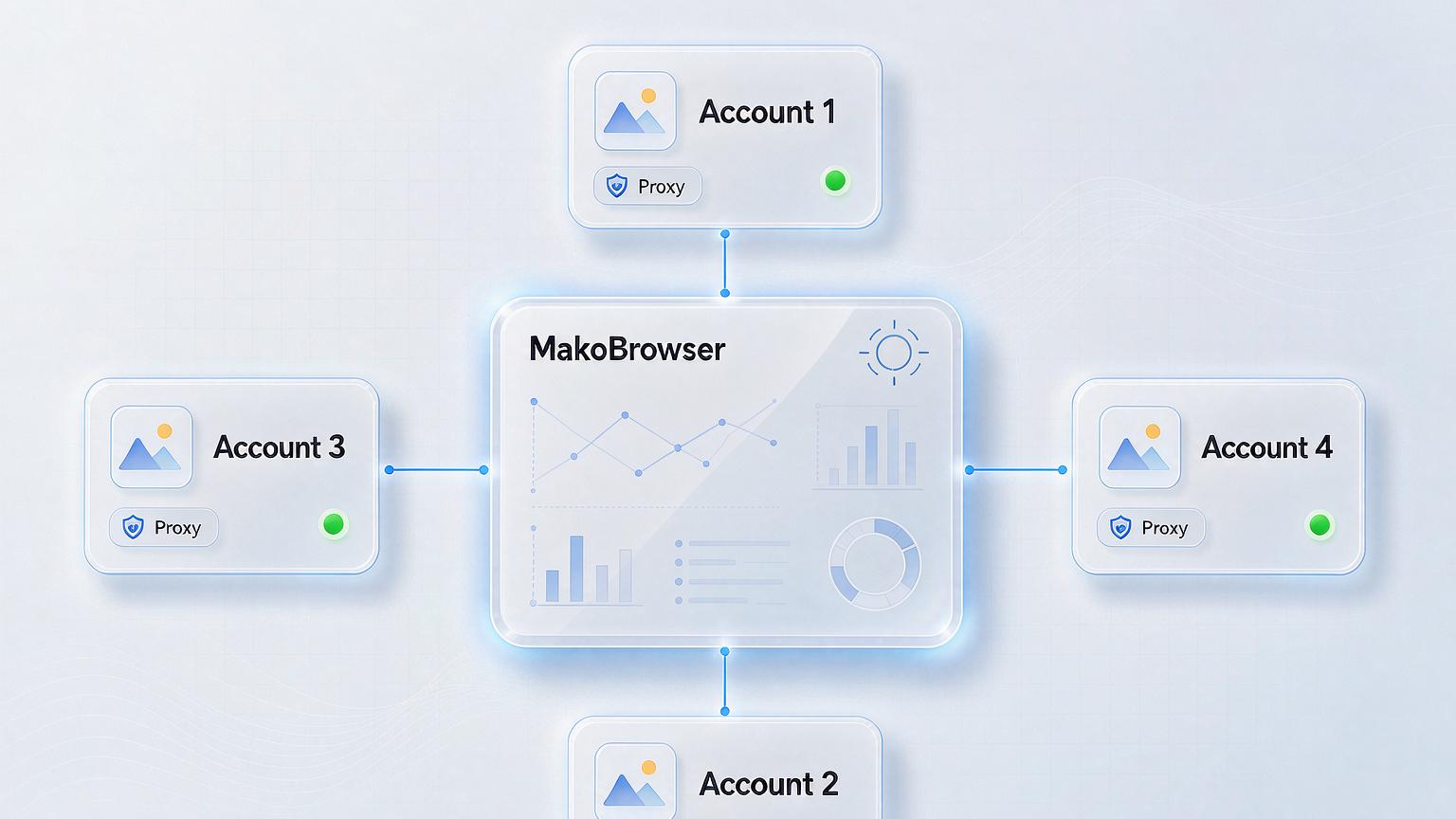
- Independent fingerprints: each environment carries its own device parameters, so the platform sees a different "device";
- Independent cookies: login sessions and browsing traces stay separate — an A-account cookie turning up in B's environment is a self-incriminating association signal;
- Independent networking: one dedicated proxy per account, with the IP's location matching the environment's timezone and language so the whole profile is internally consistent.
Build your matrix with the MakoBrowser fingerprint browser and all three layers are there by default when an environment is created: a fresh fingerprint and data directory are generated automatically, and you simply bind a proxy from the library — environments never share anything at the underlying level. Scaling from ten accounts to a hundred doesn't require rebuilding the foundation.
Content and Pacing: Matrices Die When They Look Most Like a Machine
Environment isolation solves "doesn't look like the same device"; at the operations level you also need to solve "doesn't look like the same person." Highly similar content across accounts, perfectly aligned posting times, and fully synchronized interactions are the most common cause of a mass ban after isolation is done. A few field-tested tips:
- Offset the content: accounts can cover the same themes, but assets, copy and posting frequency need genuine variation; leave real time gaps between reposts and cross-promotion;
- Humanize the rhythm: give each account its own active hours and operating cadence — don't post in a synchronized burst on the hour;
- Grow account history separately: each account's interaction record and follow graph are independent assets. Our piece on cookie management explains why cookies are an account's track record — in a matrix, cookies are never shared and never cleared.
Scaling Up: The Boundary Between Automation and Team Roles
Once the matrix runs smoothly, the growth stage involves two tasks, and each has a red line.
Automation: repetitive actions like logging in, liking and following can be batch-scripted, but keep human judgment over posting rhythm and content engagement. We drew clear boundaries on how far automation should go — and which actions should never be automated — in our piece on fingerprint browser RPA automation; you can follow it as is. Plenty of teams in this space use group-control setups to sync operations across dozens of accounts. It saves effort in the short run, but behaviorally synchronized accounts carry a very high association risk long term — we recommend treating such approaches as reference only.
Team division of labor: a matrix of any size requires collaboration, and the red line here is permissions. Who owns which batch of accounts, which environments each member can touch, and whether actions leave an audit trail — all of it should be enforced at the tool level. MakoBrowser's team mode assigns environments to members by permission and logs every action; our piece on multi-account team collaboration lays out a complete role-assignment plan, and solo operators can pick up scaling tips from our piece on multi-account management.

Checklist: Run Through This Before Launching Your Matrix
- Every account in an independent environment: fingerprint, cookies and proxy fully isolated
- Proxy location matches the environment's timezone and language
- Real variation in content and posting rhythm across accounts
- Operating hours staggered, no synchronized behavior
- Team permissions assigned per person, with an action log
- Environment data backed up regularly
FAQ
Can matrix accounts like and follow each other? Yes, but with restraint. With environments isolated, light interaction is safe; high-frequency reciprocal engagement on a fixed pattern is behavioral sync — you're exposing the association yourself.
How large a matrix can one computer run? With environment isolation, the bottleneck is proxy quality and manpower, not the machine. Tens of accounts on one device is entirely feasible — the key is never sharing environments.
Should new accounts join the matrix right away or be nurtured first? Run a new environment at "human frequency" for a week or two before entering the growth rhythm. Posting heavily on registration day is the most common rookie accident.
After being flagged as linked, is switching environments a fix? A new environment only protects future accounts; deeply flagged ones rarely recover. That's why the focus of matrix operations should always be "don't get linked," not "what to do after linking."
Closing Thoughts: A Matrix Is Won by Infrastructure, Not Hand Speed
The ceiling of an Instagram marketing matrix depends on how solid the foundation is: get environment isolation right, keep the content rhythm human, and hold the line on automation and permissions as you scale — after that, it's simply the patient daily grind. Skimp on the infrastructure, and the bigger the matrix grows, the faster it collapses.
MakoBrowser's environment isolation, proxy management and team permissions are designed for exactly this scenario, with per-environment costs kept low enough to carry you from ten accounts to a hundred (download here). Get the first ten environments stable and running for a month before you talk about scaling — that's where every healthy matrix starts.